Dropshipping vs Amazon FBA: Which Should You Choose in 2026?
- 18 min Read
- Beginner Freindly
- Checked by Chris Stone
So you’ve decided you want to build an online business and start making money from home — but now you’re stuck staring at two big options: dropshipping vs Amazon FBA. Both can be incredibly profitable. Both have launched thousands of successful online businesses. But they’re also very different in how they work, how much they cost, and how much effort they require upfront.
Don’t worry — by the end of this article, you’ll know exactly which one makes sense for YOUR situation right now in 2026. Let’s break it all down.
What Is Dropshipping? (Quick Recap)
- What is dropshipping and how does it work?
- Is dropshipping still profitable in 2026?
- Step 1: Choose a profitable niche
- Step 2: Find reliable suppliers
- Step 3: Set up your online store
- Step 4: Add and optimize your products
- Step 5: Drive traffic with free and paid methods
- Step 6: Handle orders and customer service
- Step 7: Scale your store to 6 figures
- Common dropshipping mistakes to avoid
- Frequently asked questions
What Is Dropshipping? (Quick Recap)
Dropshipping is an e-commerce model where you sell products online without ever holding any inventory. Here’s how it works:
- You build an online store (usually on Shopify)
- A customer places an order and pays you
- You forward the order to your supplier (like AliExpress, AutoDS, or Zendrop)
- The supplier ships the product directly to your customer
- You keep the difference in price as profit
You never touch the product. You never manage a warehouse.
The biggest appeal? You can start with almost no money and launch your first store within days.
What Is Amazon FBA? (Quick Recap)
Amazon FBA (Fulfillment by Amazon) is a model where you source or manufacture products, ship them in bulk to Amazon’s warehouses, and Amazon handles all the storage, packing, and shipping for you when customers buy.
Here’s how it works:
- You research and source a product (often from Alibaba or a private label manufacturer)
- You buy inventory in bulk (usually 200–500 units to start)
- You ship it to Amazon’s fulfillment centers
- Amazon lists your product on their marketplace
- Customers buy it, Amazon ships it — and you earn a profit
The big advantage? You get access to Amazon’s 300+ million active buyers without needing to drive your own traffic.
Dropshipping vs Amazon FBA: Side-by-Side Comparison
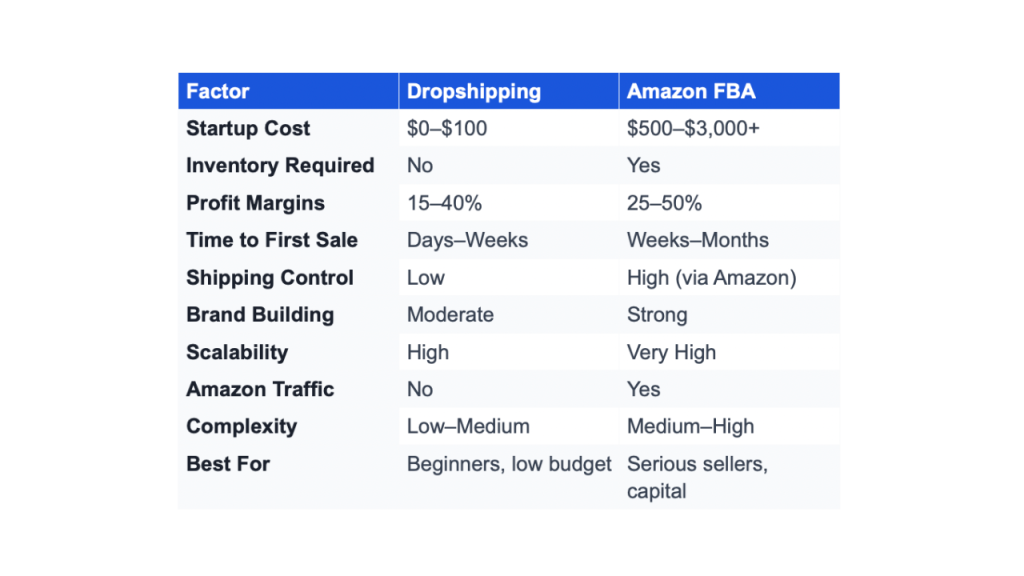
Let’s cut through the noise and look at the numbers directly:
Now let’s dig into the categories that matter most.
The Deep Dive: Key Differences Explained
1. Startup Cost: Dropshipping Wins for Beginners
With dropshipping, you can technically get started for under $100 — a Shopify trial, a domain name, and maybe a few product samples. That’s it.
Amazon FBA is a different story. Between buying your initial inventory, shipping it to Amazon’s warehouse, product photography, and Amazon’s fees, most sellers spend $1,000–$3,000+ to launch their first product — and that’s on the conservative end.
🎯 Pro Tip from Smart Drop Academy
Don’t pick a niche just because you think it’s cool. Pick it because there are real buyers who are actively searching for products in that space. Passion helps, but buyer intent pays the bills.
💡 Bottom Line:
If budget is a concern, dropshipping is the clear winner to get started without financial risk.
2. Profit Margins: FBA Has the Edge (But It’s Close)
Dropshipping margins typically run 15–40%. You’re marking up a supplier’s price, which limits how much profit you can squeeze out per sale.
Amazon FBA sellers can achieve 25–50% margins, especially with private label products where you own the brand. However, Amazon’s fees (storage, referral, FBA fees) can eat into profits significantly if you’re not careful.
💡 Bottom Line:
FBA has slightly better margins in theory, but dropshipping margins are very workable — especially when you’re selling at volume.
3. Time to First Sale: Dropshipping Moves Faster
With dropshipping, you could make your first sale within 1–2 weeks of launching — especially if you use TikTok organic traffic or run paid ads.
Amazon FBA takes much longer. Between sourcing products, waiting for samples, manufacturing, and shipping inventory to Amazon’s warehouses, you could be looking at 2–4 months before your first sale.
💡 Bottom Line:
Dropshipping is ideal if you want to see results fast and learn as you go. FBA requires patience and upfront capital before you see any return.
4. Risk Level: Dropshipping Is Much Lower Risk
Here’s the brutal truth about Amazon FBA risk: you’re buying inventory before you know if it will sell. If your product flops, you’re stuck with 300 units in Amazon’s warehouse — and paying storage fees every month to store them.
With dropshipping, you only order a product AFTER a customer pays you. If a product doesn’t sell, you just stop promoting it. No inventory. No losses on unsold stock. It’s as close to zero-risk as an e-commerce business can get.
💡 Bottom Line:
Dropshipping is dramatically lower risk. This is especially important if you’re new and still learning what sells.
5. Scalability: Both Scale Well (But Differently)
Both models can scale to serious money — $10K/month, $50K/month, even more. The difference is HOW they scale.
Dropshipping scales with traffic. More ads + winning products = more sales. You can add new products overnight with no inventory investment.
Amazon FBA scales with brand equity. Over time, you build a branded product line that customers return to, and Amazon’s algorithm rewards top-performing listings with more organic traffic.
💡 Bottom Line:
Dropshipping scales faster and cheaper. FBA scales more sustainably with a long-term brand. Ideally, you master one before adding the other.
Who Is Dropshipping Right For?
Dropshipping is the perfect starting point if you:
- Have a limited budget (under $500 to start)
- Want to see results fast — weeks, not months
- Prefer to test multiple products before committing to one niche
- Are comfortable with social media marketing (TikTok, Instagram, Facebook Ads)
- Want to learn e-commerce before investing serious capital
- Don’t want to deal with inventory, warehousing, or logistics
In 2026, dropshipping is especially powerful for people who leverage TikTok organic traffic — creating short videos that drive sales without spending on ads. You can build a real income stream with nothing but your phone and a Shopify store.
Who Is Amazon FBA Right For?
Amazon FBA makes more sense if you:
- Have $1,000–$3,000+ available to invest in inventory
- Want to build a long-term brand with repeat customers
- Are interested in private label products (your own branded goods)
- Prefer a business model driven by Amazon’s built-in search traffic
- Have patience — you’re okay waiting 2–4 months before your first sale
- Are already experienced in e-commerce and want to level up
FBA is a fantastic business model, but it requires more capital, more research, and more time before you see results. For a complete beginner, jumping straight into FBA can be overwhelming — and expensive if you pick the wrong product.
Common Mistakes People Make Choosing Between the Two
- Choosing FBA because it “sounds more legit” when you don’t have the budget for it
- Starting dropshipping without learning how to drive traffic (the store alone won’t make sales)
- Trying to do BOTH at the same time as a beginner — pick one and master it first
- Underestimating Amazon’s fees (they typically take 30–40% of your revenue in combined fees)
- Giving up on dropshipping after 2 weeks because the first product didn’t convert
The Verdict: Which Should You Choose in 2026?
🏆 Our Recommendation for Beginners:
Start with dropshipping. It’s lower risk, faster to launch, and teaches you the most important skill in e-commerce: finding what people want to buy and marketing it effectively. Once you’ve made consistent income with dropshipping, you’ll have both the cash and the product knowledge to level up into FBA if you want.
Here’s a simple decision framework:
- Budget under $500 + want to start ASAP → Dropshipping
- Budget $1,000+ + okay with 3–4 month runway → Amazon FBA
- Want to learn e-commerce fundamentals first → Dropshipping
- Already have a proven product or brand idea → Amazon FBA
- Want to use TikTok or social media to sell → Dropshipping
Frequently Asked Questions
Can you do both dropshipping and Amazon FBA at the same time?
Technically yes, but it’s not recommended for beginners. Each model requires significant focus to master. Start with one, get profitable, then consider adding the other as a second income stream.
Is dropshipping dead in 2026?
Absolutely not. Dropshipping is thriving — especially with tools like AutoDS, Zendrop, and TikTok organic making it easier than ever to source winning products and drive traffic. The key is finding the right products and marketing them effectively, which is exactly what a structured course teaches you to do.
How much can you realistically make with dropshipping?
Beginners typically aim for $500–$2,000/month in their first 3 months. Many students scale to $5,000–$10,000+/month within 6–12 months once they find a winning product-market fit. Results vary based on effort and execution.
Do I need a business license to start dropshipping?
In most countries, you can start dropshipping as a sole proprietor without any formal registration. As your revenue grows, it’s worth setting up an LLC for tax and liability protection — but it’s not required on day one.
What’s the hardest part of dropshipping vs FBA?
With dropshipping, the hardest part is driving traffic and finding winning products. With FBA, the hardest part is product research and managing capital risk before you know if your product will sell.
Ready to Build Your Dropshipping Business?
If this article convinced you that dropshipping is the right path — you’re not alone. Thousands of beginners choose dropshipping every year because of its low barrier to entry and fast path to results.
But here’s the truth: most people who try dropshipping fail not because the model doesn’t work, but because they don’t have a clear roadmap. They waste weeks testing random products, spending money on ads that don’t convert, and giving up right before they would have broken through.
That’s exactly why we built Smart Drop Academy.
🚀 Ready to Start Dropshipping?
If dropshipping is your path, here’s the fastest route to your first sale. The Smart Drop Academy Masterclass walks you through every step — from picking a winning product to making your first sale — in 25 structured lessons.
👉 Join Smart Drop Academy — and build your store today
🚀 Ready to Start Dropshipping?
If dropshipping is your path, here’s the fastest route to your first sale.
The Smart Drop Academy Masterclass walks you through every step — from picking a winning product to making your first sale — in 25 structured lessons.
👉 Join Smart Drop Academy for $97 — and build your store today
Final Thoughts
Both dropshipping and Amazon FBA are legitimate, profitable business models in 2026. Neither is “better” in every situation — it really comes down to your budget, timeline, and goals.
For most beginners, dropshipping is the smarter starting point. It’s faster, cheaper, and teaches you the foundational e-commerce skills you’ll use no matter which model you eventually scale into.
Start lean, learn fast, and build from there. Your first sale is closer than you think.