Dropshipping vs Affiliate Marketing: Which is Better for Making Money Online?
- 16 min Read
- Beginner Freindly
- Checked by Chris Stone
If you’re here, chances are you’ve been Googling “how to make money online” and stumbled across two of the most popular business models: dropshipping vs affiliate marketing. They both sound promising, they both claim you can work from anywhere, and they both flood your social media feed with success stories. But let’s be real—when you’re just starting out, all this information can feel overwhelming.
I remember when I first dipped my toes into the online business world. I was constantly bouncing between the two. One week I thought dropshipping was the way to go, then the next week I was watching YouTube videos about affiliate marketing. In the end, I wasted precious months because I couldn’t make up my mind. And here’s the truth: while both can be great ways to make money online, the right choice depends entirely on you—your budget, your personality, and your long-term goals.
So instead of letting you repeat the same mistakes I made, let’s break down dropshipping vs affiliate marketing in detail, compare their pros and cons, and figure out which one might be the best fit for you. By the end of this, you’ll have a clear direction so you can actually start building instead of just researching endlessly.
Key Takeaways (Quick Overview)
- Affiliate marketing builds slowly but compounds over time, making it ideal for creators who enjoy content, education, and long-term audience growth.
- Dropshipping can generate income faster, but requires more active involvement and ongoing management to scale sustainably.
- Affiliate income is typically more passive, while dropshipping is more hands-on but offers greater control and ownership.
- Dropshipping has a higher income ceiling because you control pricing, branding, and customer relationships.
- Affiliate marketing has lower risk, since you don’t handle products, shipping, or customer service.
- The strongest long-term strategy in 2026 combines both models, using affiliate marketing to build trust and traffic, and dropshipping to maximize revenue and brand value.
- Consistency and execution matter more than the business model itself—both can succeed or fail depending on how they’re implemented.
What is Dropshipping?
Let’s start with dropshipping because it’s the one most people hear about first.
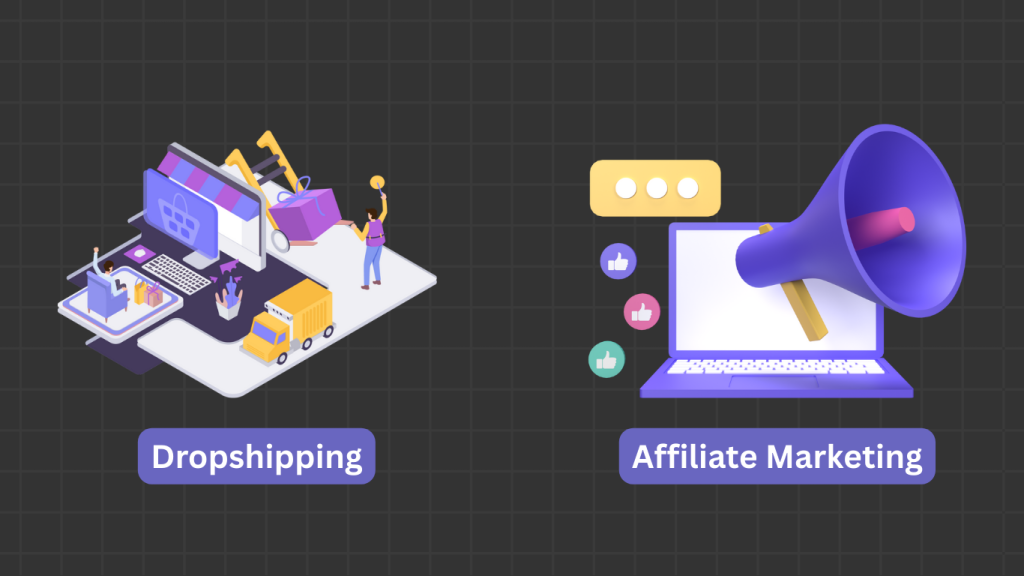
In the simplest terms, dropshipping is an online retail business model where you sell products without ever touching inventory. You set up an online store, list products, and when someone buys from you, the supplier ships the product directly to your customer. You don’t need a warehouse, you don’t need to order bulk stock, and you don’t even need to handle shipping logistics.
Here’s a real-world example: imagine you open a Shopify store selling fitness gear. A customer buys resistance bands for $30. You then pay your supplier $10 for the same bands, and the supplier ships them straight to your customer. That $20 difference? That’s your profit.
Sounds easy, right? Well, it’s not a get-rich-quick scheme, but it is beginner-friendly. The reason so many people start with dropshipping is because the barrier to entry is low. You don’t need thousands of dollars to start, and you don’t need to rent office space. All you really need is an online store, reliable suppliers, and a marketing plan to bring in traffic.z
What is Affiliate Marketing?
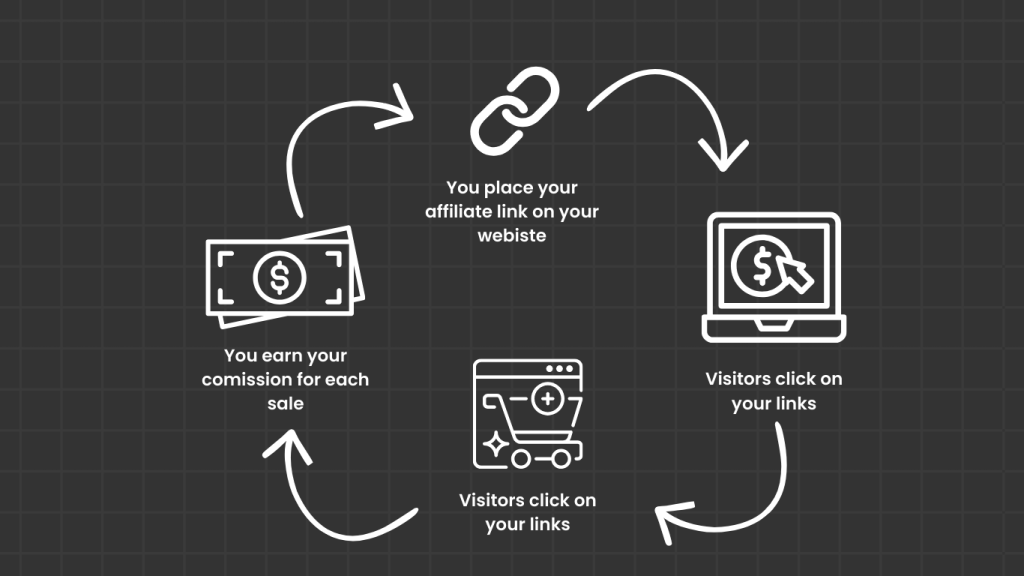
Affiliate marketing works a little differently. Instead of selling physical products yourself, you’re promoting someone else’s product or service and earning a commission whenever someone buys through your referral link.
Let’s say you sign up for Amazon’s affiliate program. You promote a $100 coffee machine on your blog or TikTok. If someone clicks your link and makes a purchase, you might earn a 5–10% commission—in this case, $5–$10. The brand handles the product, shipping, customer service, and returns. You just get paid for sending them customers.
Another example: imagine you’re promoting a digital product like an online course or software. Some programs offer commissions as high as 30–50%. That means if you recommend a $500 program, you could make $150–$250 just for one sale.
Affiliate marketing is attractive because it’s low risk. You don’t have to deal with suppliers or customer complaints. All you really need is an audience—whether that’s through social media, YouTube, blogging, or email marketing.

Dropshipping vs Affiliate Marketing: The Big Differences
At first glance, both models sound similar: you’re making money online without physically holding products. But the way they work day-to-day is completely different. Let’s break down the main differences you need to understand before choosing one.
The biggest difference is customer ownership. With dropshipping, the customer is yours. They buy from your store, they get emails from your brand, and you can re-target them later with new offers. With affiliate marketing, the customer belongs to the company you’re promoting. Once someone clicks your link and buys, that’s it—you usually don’t get to follow up with them again.
The second difference is startup costs. Dropshipping requires you to set up a store, run ads, and possibly pay for apps and tools. While it’s still cheaper than opening a physical store, it’s not free. Affiliate marketing, on the other hand, can be almost zero-cost if you’re creative. You can start a TikTok account or write blogs with very little investment and start promoting affiliate products.
Third, let’s talk about profit margins. Dropshipping usually gives you a bigger chunk of each sale, but you also have expenses like advertising and transaction fees that eat into your profit. Affiliate marketing commissions vary widely, and while some can be generous, others are so small that you’ll need massive traffic to make decent money.
Finally, consider the level of risk. With dropshipping, you’re responsible for customer satisfaction. If shipping is slow or the product is poor quality, your store takes the blame. With affiliate marketing, you don’t handle any of that—but you also don’t control much of the customer’s experience.
The Pros and Cons of Dropshipping
✅ Pros of Dropshipping
Low startup costs compared to traditional retail.
No need to handle inventory, packaging, or shipping.
Wide variety of products to sell from multiple suppliers.
Easy to scale once you find winning products.
You own the customer data and can build a long-term brand.
❌ Cons of Dropshipping
- Slim profit margins due to ad costs and supplier pricing.
- Heavy competition in trending niches.
- Customer service and refund requests fall on you.
- Reliance on suppliers for quality and shipping speed.
- Ads and marketing expenses can get expensive quickly.
The Pros and Cons of Affiliate Marketing
✅ Pros of Affiliate Marketing
- Very low cost to start (sometimes free).
- No need to deal with customer service or shipping.
- Potential for passive income once content is ranked or automated.
- Can promote both physical and digital products.
- Flexible—you can test different niches without heavy investment.
❌ Cons of Affiliate Marketing
You don’t own the customer or their data.
Commission rates can be low depending on the program.
Your income depends on the affiliate company’s rules.
Competitive market, especially in popular niches.
Takes time to build traffic and authority before earning consistently.
Which is Easier for Beginners?
Here’s the question everyone asks: if you’re starting from scratch, which one should you choose?
If you’re short on money and want to test the waters with minimal risk, affiliate marketing is easier. You can start creating TikToks, Instagram posts, or blog articles promoting products you already use and love. The learning curve is less steep, and you won’t be stuck dealing with angry customers if something goes wrong.
However, if you’re serious about building a business that you fully own, dropshipping is the stronger option. Yes, it takes more effort, more learning, and a bit of investment, but you gain something valuable: control. You own the customer list, the brand, and the store. That means you can pivot, test new products, and eventually even grow into private labeling or your own branded products.
When I first started, I jumped straight into affiliate marketing because it was easy and free. I made a few commissions here and there, but it wasn’t life-changing money. Once I switched to dropshipping and treated it like a real business, my results multiplied. But I’ll be honest—it also came with headaches.
Which Makes More Money Long-Term?
This is one of the most important questions—and also one of the most misunderstood. When people ask which makes more money long-term, what they’re really asking is: Which one gives me stability, growth, and freedom over time?
The honest answer is that both affiliate marketing and dropshipping can be highly profitable long-term, but they grow in very different ways. Understanding how each model behaves over time will help you choose the one that fits your goals, patience level, and lifestyle.
Affiliate Marketing Long-Term
Affiliate marketing is often a slow burn at the beginning, especially if you’re using content platforms like blogs, YouTube, or organic social media. In the early stages, you may spend weeks or months creating content with little to no income. This is where most people quit.
However, this is also where affiliate marketing shines long-term.
Once your content gains traction—whether it’s ranking on Google, going viral on social media, or building an engaged email list—your income begins to compound. A single piece of content can continue to generate commissions for months or even years with little ongoing effort.
Long-term benefits of affiliate marketing include:
Income that grows as your content library grows
The ability to earn while not actively working
Lower stress due to no customer support or fulfillment
Scalability without needing to manage operations
That’s why affiliate marketing is often described as “passive”—not because it’s effortless, but because the work you do today can keep paying you in the future.
That said, affiliate income is still dependent on:
Platform algorithms
Affiliate program rules
Traffic sources you don’t fully control
So while it can feel passive, it’s not completely hands-off.
Dropshipping Long-Term
Dropshipping tends to produce faster results upfront, especially when using paid advertising. Once you find a winning product and a solid offer, you can start seeing sales within days instead of months.
However, dropshipping is more active income. You’re constantly involved in:
Product testing
Ad optimization
Supplier communication
Customer support
Store improvements
The long-term advantage of dropshipping is ownership. You’re not just earning commissions—you’re building an asset.
Over time, a successful dropshipping store can:
Develop brand recognition
Build a loyal customer base
Collect valuable customer data
Expand into private labeling or custom products
Become a sellable business
When done correctly, dropshipping has a higher income ceiling than affiliate marketing because you control pricing, branding, and customer relationships. But that upside comes with responsibility and ongoing effort.
So Which One Wins Long-Term?
There’s no universal winner—it depends on how you define success.
If your goal is freedom, flexibility, and semi-passive income, affiliate marketing often wins long-term.
If your goal is scaling revenue, building a brand, and owning a real business, dropshipping has more upside.
That’s why in 2026, many smart entrepreneurs don’t choose just one.
They use affiliate marketing as a foundation—building traffic, trust, and an audience—then use dropshipping as a growth engine to increase revenue and control.
This combination allows them to benefit from both:
The compounding nature of content-based income
The scalability and ownership of eCommerce
Long-term wealth isn’t about picking the “better” model—it’s about building systems that grow with you.
Ready to Start Your Dropshipping Journey?
Learning how to start dropshipping with no money is just the first step. If you want a clear roadmap with proven strategies, I’ve put together a Free 4-Day Dropshipping Training that will show you exactly how to:
Pick winning products that actually sell
Set up a store without wasting time or money
Drive free traffic to your store and start making sales
Take your first step toward building a profitable online business today! No email require!
Common Mistakes to Avoid
Most people don’t fail at dropshipping or affiliate marketing because the model is “dead.” They fail because they repeat the same beginner mistakes that thousands of others make before them. Understanding these mistakes early can save you months—or even years—of frustration.
Dropshipping Mistakes Beginners Make
1. Chasing Viral Products Blindly
One of the biggest mistakes new dropshippers make is jumping on viral products without doing proper research. Just because a product is trending on TikTok or Instagram doesn’t mean it’s profitable or sustainable.
Viral products often come with:
Extreme competition
Saturated ad feeds
Suppliers overwhelmed with orders
Poor quality control
By the time most beginners launch their store, the trend is already dying. Instead of chasing hype, successful dropshippers in 2026 focus on problem-solving products, consistent demand, and niches where branding actually matters.
2. Ignoring Branding and Customer Trust
Many beginners treat dropshipping like a quick flip rather than a real business. They create generic stores with random product pages, no story, and no trust signals.
Modern consumers are smarter. In 2026, people expect:
Clean website design
Clear product descriptions
Social proof (reviews, UGC, testimonials)
A recognizable brand identity
Without branding, visitors don’t trust your store—and no trust means no sales. Even simple branding efforts can dramatically increase conversions.
3. Choosing Unreliable Suppliers
Your supplier is the backbone of your dropshipping business. Beginners often choose suppliers based only on price, ignoring shipping speed, product consistency, and communication.
Unreliable suppliers lead to:
Long shipping times
Tracking issues
Inconsistent product quality
Refunds and chargebacks
These issues don’t just hurt your profits—they damage your reputation. Smart dropshippers test products themselves, communicate with suppliers, and prioritize reliability over the cheapest price.
4. Underestimating Customer Service
Many beginners assume that because they don’t ship products themselves, customer service won’t be a big deal. In reality, customer service becomes your responsibility.
You’ll deal with:
“Where is my order?” emails
Refund requests
Product complaints
Payment disputes
If you’re not prepared, this can quickly become overwhelming. Successful dropshippers set up clear policies, automated responses, and realistic shipping expectations from day one.
5. Believing Ads Equal Instant Success
Running ads does not guarantee sales. Many beginners think launching Facebook or TikTok ads means money will instantly start flowing in.
In reality:
Ads require testing
Creatives need optimization
Messaging matters more than budget
Losses are part of the learning curve
Advertising is a skill—not a shortcut. Those who succeed treat ads as data collection, not gambling.
Affiliate Marketing Mistakes Beginners Make
1. Spamming Affiliate Links Everywhere
One of the fastest ways to fail in affiliate marketing is spamming links in comments, DMs, or random posts without context or value.
Modern audiences can instantly tell when someone is only trying to make a commission. This destroys trust and often leads to shadow bans or account restrictions.
Successful affiliates focus on education, storytelling, and genuine recommendations—not link dumping.
2. Promoting Products They Don’t Trust or Use
Promoting products you don’t believe in is a short-term mindset that kills long-term income.
When you promote low-quality or misleading offers:
Refund rates increase
Your credibility drops
Your audience stops listening
In 2026, trust is currency. The best affiliates only promote products they would confidently recommend to a friend.
3. Relying on One Platform Only
Many beginners build their entire affiliate business on one platform—TikTok, Instagram, YouTube, or Google—and ignore diversification.
This is risky because:
Algorithms change
Accounts get banned
Traffic can disappear overnight
Smart affiliates spread their presence across multiple platforms and always aim to own their audience, not rent it.
4. Expecting Instant Results
Affiliate marketing is often marketed as passive income, but beginners take this too literally. Content takes time to rank. Trust takes time to build.
Most people quit after a few weeks because they don’t see immediate results—right before momentum would have started.
Consistency beats talent every time.
5. Not Building an Email List
This is one of the most expensive mistakes beginners make.
Without an email list:
You can’t follow up with your audience
You lose visitors forever
You rely entirely on platforms
An email list gives you control, stability, and long-term income potential. Even a small list can outperform thousands of social media followers.
The Real Reason Most People Fail
Failure usually isn’t about dropshipping vs affiliate marketing.
It’s not about the niche.
It’s not about the platform.
It’s not about timing.
It’s about execution, patience, and consistency.
The people who succeed aren’t smarter—they just stick around long enough to learn what actually works.

Why Not Both? The Hybrid Model
Here’s a little secret: you don’t actually have to choose one or the other. Many successful entrepreneurs combine dropshipping and affiliate marketing into one business.
For example, imagine you run a pet store online. You can dropship toys, beds, and collars, but at the same time, you can recommend affiliate products like pet insurance, grooming products, or even dog training courses. You’re still earning from your store, but you’re also stacking affiliate commissions on top.
This hybrid approach creates multiple streams of income and makes your business more resilient. You’re not putting all your eggs in one basket.
Final Verdict: Which Should You Pick?
So here’s the final answer: dropshipping vs affiliate marketing—neither is “better” in every situation. It depends on what you want.
If you want to start fast with little money, focus on building content, and dream about passive income, affiliate marketing is a great entry point. If you’re ready to invest a little, work harder upfront, and build something that’s more under your control, dropshipping might be the smarter choice.
The key is not to get stuck in research mode like I did. Pick one, stick with it for at least six months, and give yourself permission to make mistakes along the way. Every successful person in this space failed a hundred times before finding their stride.
At the end of the day, the “best” online business model isn’t about dropshipping vs affiliate marketing—it’s about consistency. Both can make you money online. Both have success stories and both have failures. The real difference is whether you’re willing to stick it out long enough to learn and grow.
So don’t waste another year scrolling through videos and blog posts wondering which is better. Pick one path, commit, and see where it takes you. Even if your first attempt doesn’t work out, you’ll learn skills that transfer to the next thing. And that’s how real entrepreneurs are made—not by chasing perfection, but by taking action.